

An AI feature in an e-commerce store needs a clear purpose. Answering a product question, improving search results and helping a shopper compare alternatives are different tasks. Each needs access to the right information and a way to assess whether it helps the customer complete their purchase.
A separate assistant can be useful, but shoppers have to notice it and choose to use it. Integrating AI into search, navigation or product pages brings those capabilities into the journey they are already following.
This can change how the store searches, ranks, filters, and presents product information. The choice of feature should follow the problem observed in the shopping journey. External commerce data provides context: Shopify's own commerce data from the first quarter of 2026 reports AI-referred orders growing almost thirteenfold year over year. Among sessions starting on product detail pages, AI-referred visitors converted at nearly 50 percent higher rates than organic-search visitors. Those figures describe referral traffic; they do not measure the effect of adding AI to a store’s own interface.
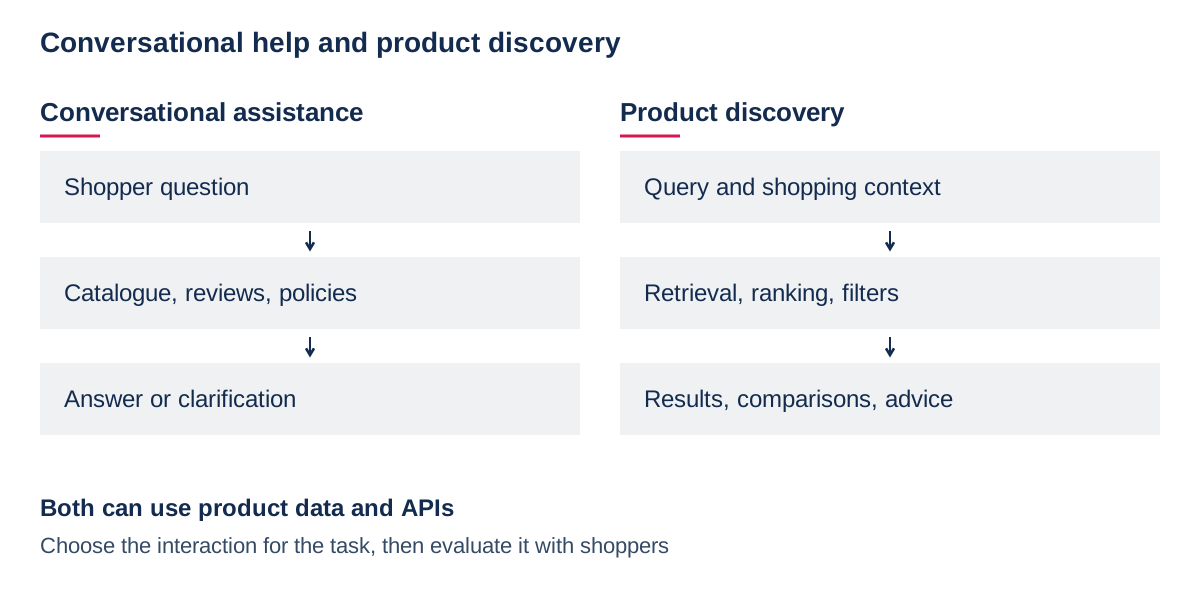
Three parts of the shopping experience
When assessing an e-commerce platform, we look at three connected areas:
- The visual layer includes product images and other assets that help shoppers understand what is being sold.
- The structural layer includes search, taxonomy, product pages, navigation and checkout: the steps through which a shopper finds and chooses a product.
- The signal layer captures behaviour such as clicks, hesitation and reformulated searches, which can inform changes to the experience.
Search structure and behavioural signals deserve attention alongside visual assets. They help identify where shoppers struggle and provide a basis for evaluating changes.
McKinsey's research on personalization reports a typical revenue lift of 10 to 15 percent, with company-specific results ranging from 5 to 25 percent depending on sector and execution. Published in 2021, the research covers personalization broadly, including decisions about which products and information to show, in what order and to whom. These figures provide context rather than a forecast for an individual store.
The practical question is where a change would help a shopper most: understanding the product, finding an appropriate option or resolving uncertainty before buying.
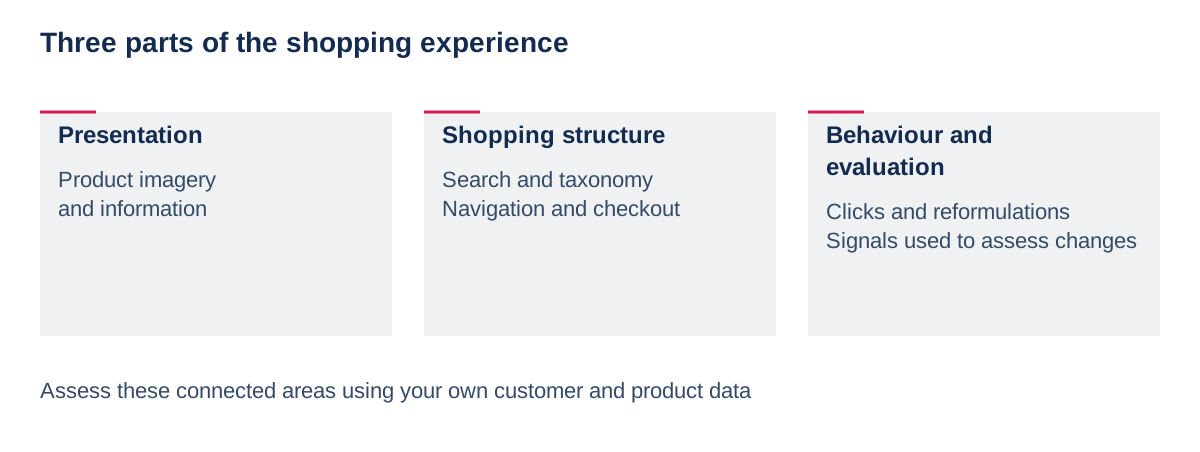
Integrating AI into the shopping journey
AI can return structured data that the interface renders as product recommendations, filters, size advice or a reordered set of results. A model can call product APIs and use retrieval-augmented generation (RAG) to ground responses in the store’s catalogue, reviews and policies. The frontend then presents the result within the relevant part of the shopping journey.
For example, a shopper might ask for a lightweight rain jacket that packs easily for travel. The store can use that request to retrieve products, rank suitable options, ask a clarifying question and present a comparison. AI can also support the people managing the store. Shopify's Sidekick works in the store admin and can propose merchandising actions and store changes. This is a different use case from shopper-facing discovery, but it also depends on connecting AI to the store’s data and operations.
The systems behind the experience
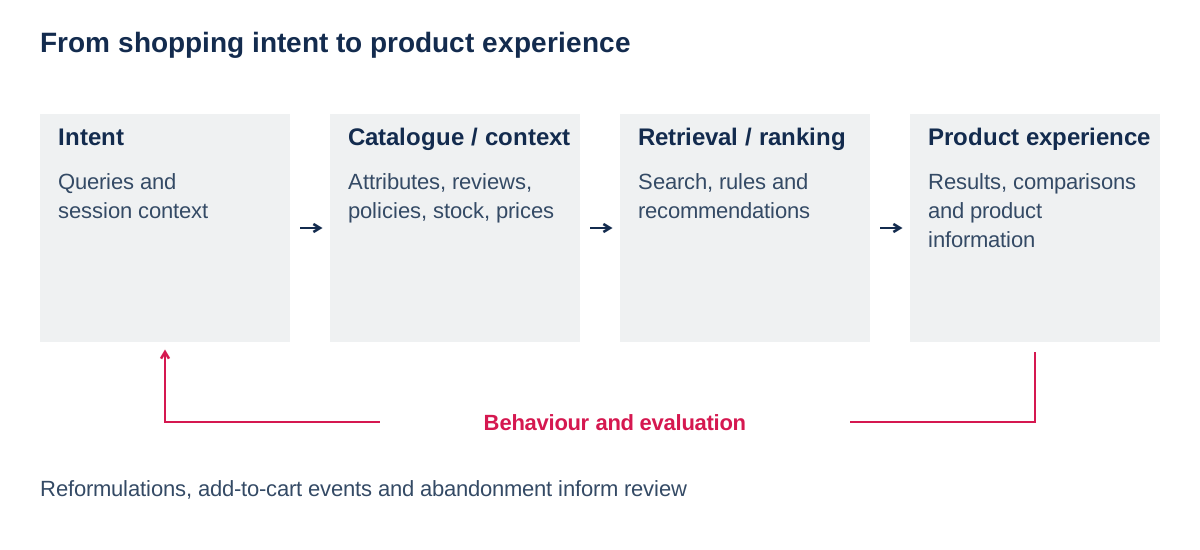
An integrated experience needs several connected components. Queries, clickstream data and session context provide information about intent. A normalized catalogue supplies attributes, reviews, policies, stock and pricing. Retrieval, ranking, rules and recommendation models determine what to return, with a language model coordinating tasks where useful. The interface presents the results through search, collection pages and product information. Behavioural signals, including reformulations, add-to-cart events and abandonment, help teams evaluate and refine the experience.
These components allow AI-assisted features to influence navigation, page content and result ordering. That makes their behaviour part of the application’s design and testing responsibilities.
Choosing a starting point
Search and discovery are useful places to investigate because shoppers often express a specific buying intention there. Hello Retail’s search measurement overview offers a starting point for the metrics to track. Use your own queries, unsuccessful searches and conversion data to assess ranking, merchandising and product-page information. Review summaries, fit advice, alternatives and bundles may help with particular decisions. Returns and order-status questions are another possible use case, with human escalation where needed. Asset generation should be evaluated against the store’s content needs.
Preparing the platform and evaluating changes
Begin with catalogue quality: consistent attributes and taxonomy, reliable internal APIs, and embeddings where semantic retrieval is useful. Hybrid discovery can combine keyword and vector retrieval while retaining familiar filters. Intent interpretation and clarifying questions can help when a request is ambiguous. Assess which of these capabilities the existing platform can support before deciding on a rebuild.
Product pages can present review summaries, fit information, compatibility and comparisons within the page layout. Define quality evaluations, collect telemetry and set latency budgets as part of the implementation. These checks give the team a way to assess both the usefulness of the output and the behaviour of the feature in production.
Assessing your store
Customer expectations are relevant to this assessment. In its 2021 research, McKinsey found that 71 percent of consumers expect personalized interactions and 76 percent become frustrated when they do not receive them. These findings describe consumer expectations broadly; they do not specify which AI feature a store should build. That decision needs evidence from its customers, catalogue and shopping journey.
We work with store teams to review those needs, identify the systems involved and agree what to evaluate. If you are considering changes to your commerce platform, we can help assess the scope and where to begin.